The Story Behind the Dinner Jacket
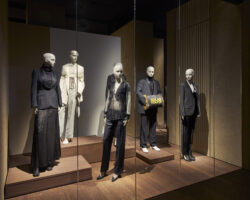
The dinner jacket is one of the most recognisable garments in fashion history. Yet it has never been a fixed or definitive form. Since its emergence in the 19th century, the archetype has continued to inspire designers to question and reinterpret established codes.
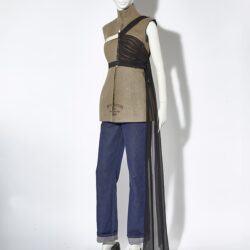
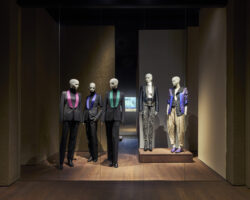
From Yves Saint Laurent’s iconic 'Le Smoking' to designs by Martin Margiela, Veronique Branquinho, Haider Ackermann, Helmut Lang and Raf Simons, the same starting point has been given countless different interpretations.
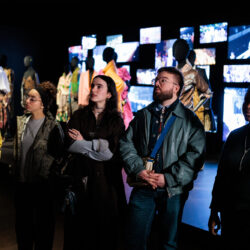
At the heart of a new selection within Deconstructed Archetypes, part of MoMu's collection presentation, is the dinner jacket. Curator Romy Cockx explains why a single garment has remained a source of inspiration for more than 150 years.
Why does the dinner jacket continue to fascinate designers?
ROMY COCKX: "It is a recognisable garment with a complex history that lends itself to reinterpretation. A classic dinner jacket has a number of distinctive features, such as satin lapels and a single-button fastening at the waist. The formal evening jacket was traditionally worn exclusively by men, usually as part of a ‘black tie’ dress code, paired with matching black trousers, a white shirt and a bow tie, sometimes complemented by a waistcoat or cummerbund. Designers are fascinated by the possibility of reinterpreting these characteristics and established codes."
When does a dinner jacket stop being a dinner jacket?
RC: "That depends on how you look at it. We found it interesting to include examples that push the boundaries of the archetype, so the selection is open to interpretation. At first glance, for instance, I didn’t necessarily see some of Martin Margiela’s pieces as dinner jackets. But on closer inspection, they contain recognisable elements of one."
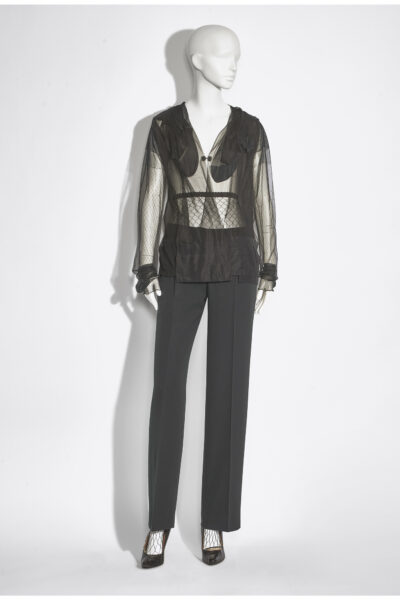
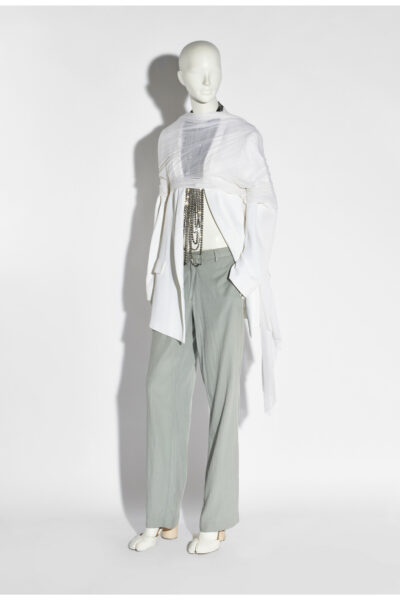
RC: "The ensemble from the Spring-Summer 2005 collection consists of a completely transparent jacket made from vintage nylon stockings, yet its cut still alludes to the dinner jacket. The silhouette from the Spring-Summer 2004 collection could be seen as a radical reinterpretation of the white dinner jackets that became popular from the 1940s onwards."
What does the dinner jacket tell us about fashion?
RC: "The dinner jacket shows how the meaning, ways of wearing and etiquette surrounding a garment can change over time. It began as an informal jacket worn by men in the smoking room, where they would retreat after dinner. Gradually, it evolved into the most formal garment in the male wardrobe.
Yves Saint Laurent made the dinner jacket accessible to women in 1966. Today, no one would find it unusual to see a dinner jacket worn during the day with a pair of jeans. Yet, consciously or unconsciously, its complex and gendered history still resonates."